ARTICLE
In many companies, application architecture remains tied to models from the past: monolithic solutions deployed on physical or virtual machines, managed by separate development and operations teams. This fragmentation slows down processes, increases costs, and limits the ability to respond quickly to change. The result is slow and rigid release cycles (code freeze, testing, deployment), greater exposure to security risks, and reduced attractiveness for digital talent, who are increasingly drawn to dynamic, modern, and collaborative environments.
According to a recent IDC survey, only 30% of companies report having developed truly effective cloud-native processes, while Gartner estimates that by 2027 more than 90% of G2000 companies, the 2,000 largest global enterprises, will use container management tools in their hybrid environments.
Organizations that do not begin a modernization journey now risk being left behind within just a few years.
The factors driving change are not only technological. End-user expectations, increasingly shaped by continuous, seamless, and personalized digital experiences, continue to rise. In 2025, the typical user expects frequent new features, instant support, and services available at all times. At the same time, business leaders are paying growing attention to three key areas:
- reducing time-to-market
- governing cloud costs
- addressing the shortage of technical skills in strategic areas such as DevOps and cybersecurity
In this context, undertaking a journey of application modernization based on containerized architectures and orchestrated microservices represents a strategic lever for ensuring agility, operational efficiency, and risk control.
From the traditional model to the container-native paradigm
In the traditional application model, software is developed as a single block, tightly coupled to the environment in which it runs. Every phase, from development to testing and release, requires adaptations, specific configurations, and often long periods of activity freeze. This slows innovation and increases the risk of errors.
The container-native paradigm overcomes these limitations: applications are split into independent microservices, each enclosed in a “container” that includes everything required to run correctly, regardless of where it is executed. The same component can run identically on a developer’s laptop, in a corporate data center, or in the cloud, ensuring portability, consistency, and speed.
At the center of this new approach is Kubernetes, a platform that manages and coordinates containers, automating complex tasks such as load balancing, scaling, and recovery in the event of failure. However, having a technical platform alone is not enough: well-orchestrated release processes are also required.
This is where the CI/CD (Continuous Integration / Continuous Delivery) model comes into play, automating testing, validation, and deployment while ensuring quality and speed. With the GitOps approach, infrastructure is also managed as code, improving control, security, and traceability of every change.
The cultural shift of CI/CD
To understand the real impact of the CI/CD approach, it is enough to compare a traditional release with a fully automated one. In the first scenario, every deployment involves manual intervention: merge conflicts resolved by hand, error-prone local builds, last-minute changes to configuration files such as Docker Compose or Kubernetes, and SSH (Secure Shell) access to staging servers to fix “on the fly” whatever does not work. A slow, fragile process with a high risk of human error.
With a well-designed CI/CD pipeline, on the other hand, everything is triggered automatically: from the first code push, the system compiles, runs tests, generates the container image, signs the supply chain, updates the manifests, and synchronizes the application state in the cluster using tools such as Argo CD.
If a test fails, the pipeline stops and notifies the team. If everything is compliant, the release to the development environment is immediate, and the move to production can take place with a simple click. Techniques such as canary or blue-green deployment also make it possible to expose new versions to only a portion of users, reducing risk and simplifying potential rollbacks.
The benefits are not only technical but also measurable in terms of business impact. Where release cycles once took 90 days, teams now work in weekly or daily sprints. Mean time to recovery in the event of an error drops from several hours to just a few minutes. And incidents related to incorrect configurations fall dramatically, thanks to peer-to-peer review of infrastructure code.
According to the State of DevOps Report, organizations that adopt CI/CD pipelines record a 60% increase in deployment speed and a 25% to 30% reduction in operating costs.
Factors driving change
Four main drivers are fueling the urgency to begin a containerization journey:
- Time-to-market under pressure. In a constantly evolving market, new features must be released in days, not quarters. Every delay exposes the company to the concrete risk of losing market share and competitive relevance.
- Elasticity during workload peaks. Industries such as e-commerce, streaming, and fintech are subject to strong seasonality and sudden traffic fluctuations. Infrastructures must be able to scale automatically, avoiding waste and over-provisioning.
- Adoption of AI and analytics. Artificial intelligence pipelines, both real-time and batch, require flexible, distributed, and highly scalable environments. Microservices and event-driven architecture provide the level of modularity and performance required to support these workloads.
- Growing security risks. Supply chain threats, as well as cloud misconfigurations, require more secure models with isolated, immutable, and traceable environments from the moment of build, capable of ensuring auditability and resilience.
Guiding principles
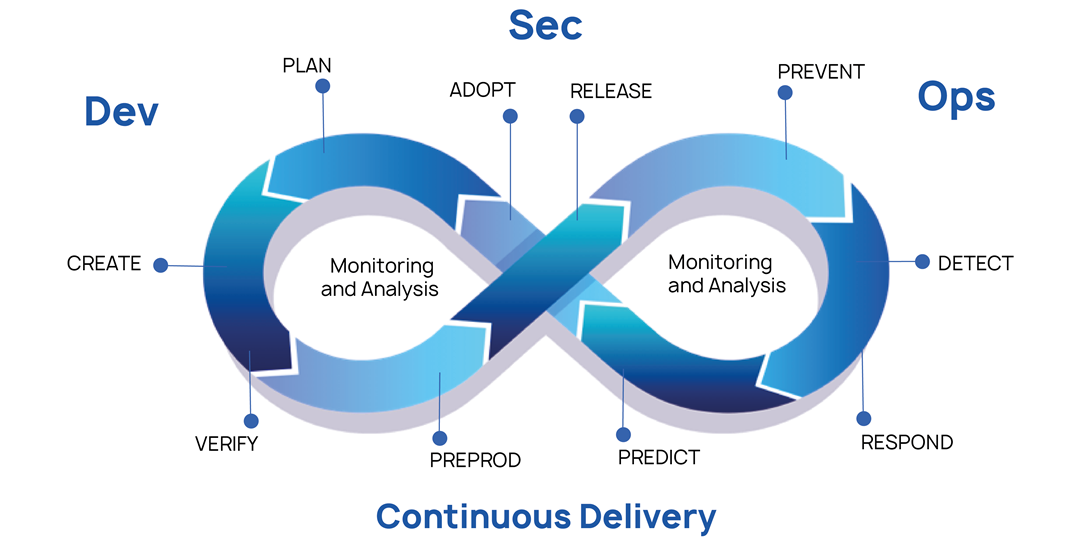
Portability, automation, observability, and continuous security: these are the four pillars identified by the DevSecOps Manifesto. In practical containerization, they translate into very concrete architectural and operational choices:
- Immutable images → code is “packaged” together with its dependencies, ensuring that it behaves in the same way in every environment, from a developer laptop to the production cloud.
- CI/CD automation → pipelines eliminate repetitive manual tasks, standardize processes, and reduce the risk of human error.
- Centralized observability → unified collection and analysis of metrics, logs, and traces to provide end-to-end visibility into application behavior.
- Policy and security by design → validation rules automatically check resources before they are deployed across different environments.
From theory to practice: the four-step roadmap
1. Initial assessment
The process starts with a detailed inventory of applications, dependencies, SLAs, costs, and risks. This step is essential for defining priorities: not everything needs to be containerized immediately. In general, organizations start with services that change frequently or that can benefit most from elastic scalability.
2. Adoption of the container platform
Kubernetes comes into play as the orchestration layer. In enterprise environments, tools such as SUSE Rancher or managed solutions from cloud providers offer advanced features such as centralized RBAC, single sign-on, and audit logging.
The platform enables vertical and horizontal autoscaling, live updates (rolling updates), and self-healing capabilities.
3. Implementation of CI/CD and GitOps
Automated pipelines using GitHub Actions or GitLab CI manage the entire cycle: testing, image builds, and promotion across environments. Tools such as Argo CD or Flux keep the desired state synchronized within the cluster.
Kubernetes manifests live in the same repository as the code, following versioning principles. The Shift-Left philosophy integrates security into the development process through automated testing of code and dependencies (SAST, DAST, SCA).
4. Governance, observability, and cost management
In production, dashboards such as Grafana and alerting with Prometheus provide visibility and control. OPA policies verify that only signed and authorized images are executed. FinOps tools analyze resource usage and suggest rightsizing actions to optimize costs.
Tangible benefits
The containerization journey delivers tangible benefits that can be measured across the entire value chain.
Time-to-market can be reduced by up to 70%. Features that once required months can be released in weeks. Infrastructure becomes more efficient, with a 25-30% reduction in operating costs thanks to elastic resource usage. Deployments become up to 60% faster, while application resilience increases significantly thanks to distributed failover and self-healing mechanisms.
The challenges? Manageable with the right vision
No significant transformation is free of obstacles. Introducing new platforms and practices requires investment in skills, tools, and culture. Some functions may perceive containerization as a source of risk or complexity.
But this is precisely where the difference lies between tactical adoption and an evolutionary strategy: starting with a pilot project, measuring the results, and scaling progressively.
Training is a key accelerator: practical workshops on Kubernetes, GitOps, and container security enable teams and reduce friction around change.
Support from top management is critical. If containerization remains confined to the IT domain, it loses its transformative power. But if the CFO views it in terms of ROI, flexible CapEx, and cost predictability, and the CISO sees it as a lever for security and native compliance, then it becomes a shared strategy.
Containerize to compete
Containerization is not a purely technological choice. It is an act of strategic modernization. It enables faster innovation, the creation of resilient environments, the attraction of talent with up-to-date skills, and the ability to measure each release in terms of real business impact.
In a scenario where more than 90% of workloads will be containerized over the next two years, standing still means giving up speed, flexibility, and ultimately competitiveness.
When approached with vision and awareness, containerization is not merely a technological change, but a concrete opportunity to make IT faster, more flexible, and more strategic. Organizations that begin this journey today will be ready to compete and innovate tomorrow.